
SAFARI & TOUR OF CHOBE NATIONAL PARK IN BOTSWANA
Learn More On AfricanMecca Safari Tier Ratings & Experiences For Botswana
CONTACT AN EXPERT ON CHOBE SAFARIIntroduction To Chobe National Park
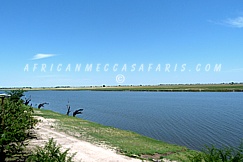
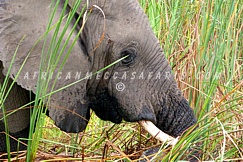
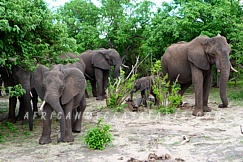
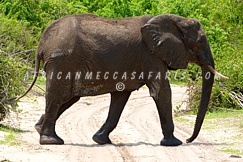
Chobe National Park is Botswana’s first national park declared in 1967 covering around 11700 square kilometers. Famous as the elephant capital of Africa, the park derived its name from the Chobe River and located on the northern part of Botswana near Zambia, Zimbabwe and Namibia. The Chobe River is the main source of water for the park and comprises of mopane woodland, floodplains, grasslands and combretum offering diversity in its ecosystem. It has one of the largest concentrations of African elephants. General game viewing and birdlife are superb all year around with the elephant, buffalo and zebra masses being seasonally migratory based on accessibility to water and food.
Flora & Fauna Experiences Of Chobe National Park
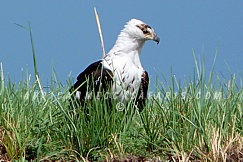
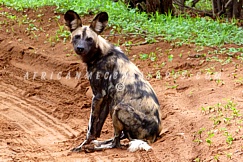
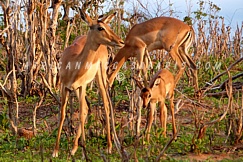
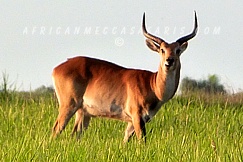
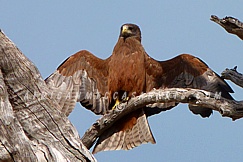
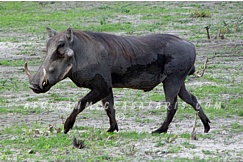
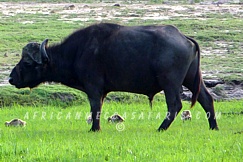
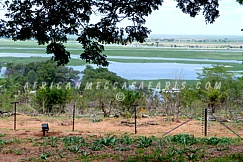
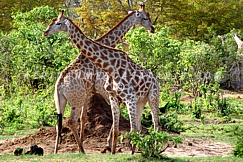
The park boasts of a variety of flora and fauna based on its 4 unique ecosystem namely the Serondela area or Chobe riverfront, Savuti Marsh area, Linyanti Marsh and Ngwenzumba Pans. The park is home to predators such as lion, leopard, hyena, jackal, wild dog, cheetah etc. The park offers herbivores such as buffalo, zebra, giraffe, roan and sable, red lechwe, waterbuck, bushbuck, puku, tsessebe, eland and many more. It is also a picture-perfect place for bird viewing with many species seen such as Spur-winged Geese, Pel’s Fishing Owl, Carmine Bee-eaters, most kingfishers, rollers, storks, Fish Eagle, Martial Eagle, Sacred ibis, Egyptian Geese, cormorants, darters and many more. Found at the northeast of the park, the Serondela Area or Chobe Riverfront serves as a catch basin for the Chobe River. The Serondela is the watering spot of the park especially during the dry winter season where large concentrations on elephants flock to the river bank. Part of it has lush floodplains that serve as the only home of the puku antelopes. Mahogany, teak and other hardwoods cover the area. Game watching at the Chobe riverfront is accessible and exceptional thus also luring many guests from the nearby Victoria Falls in Zambia and Zimbabwe - perfect for a day Chobe safari or overnights safari too. Located at the western side of the park, the Savuti Marsh area derives its water from the Savuti Channel waters erratically. This characteristic of the region formed the place into grasslands and savannahs. These became home to various species of wildlife including birdlife. Settlers name the Linyanti Marsh after the Linyanti River, a primary source of water for the marsh. Situated at the northwest corner of the park, Linyanti has lagoons, woodlands, riverine thickets and floodplains. Linyanti harbors diversity of fauna, also has the migratory elephants, buffalos and zebras that arrive during the start of the dry winter season. Around 70 kms south of the Chobe River is the Ngwezumba Pans which are a collection of individual pans surrounded by grasslands and mopane woodlands. During the wet summer month, the clay pans are a catchment for water allowing wildlife to migrate away from Chobe and Linyanti Rivers and search for more food and area to roam.
When To Visit Chobe National Park For Your African Safari In Botswana
The Chobe National Park is an enthralling place to visit for your Botswana safari any time of the year depending on your interests. Water supply largely affects the in and out migration of animals around the park and beyond. The rainy and dry season commands the wildlife concentration in the area. The dry season is May to October. This is the time the Chobe becomes densely populated with elephants and other animals from dry inland areas converging at the Chobe and Linyanti rivers for water. This is one of the superior times for your African safari in Botswana. In addition, the heat during these months dries up the trees and shrubs leaving them to lose their leaves or eaten by the migratory and resident herbivores. This shedding of leaves though is beneficial to game viewers as it makes it easier to watch the wild animals in the dry season when it is less dense. During the rainy season from November to April, there is an abundance of wild flowers that are amazingly beautiful. The different kinds of flowers display a myriad of colors which blend with the green, grassy slopes of the park and the riverbanks. Birds are also abundant during this time of the year while the elephants and other animals wander or migrate around the park since there is more water availability everywhere. During this time, game viewing experiences requires more patience than normal as the renewed lush environment of tall trees and robust grasses usually conceal the animals or may have migrated away. It is an opportune time though to witness the animals in their natural green habitat. The intermingling of rich, colorful flora and fauna is a breath taking sight.

Chobe National Park Activities During Your Safari In Botswana
Chobe National Park boasts of its renowned game driving and boating safaris (river front areas).
Chobe Game Driving Safari In Botswana, Africa
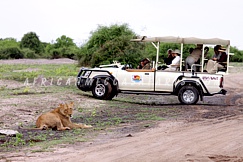
The game drive into the Chobe National Park gives visitors the most rewarding experience with nature. During your game drive, you can encounter enormous herds of elephant and buffalo with various predators. Plains game and bird species on offer is astonishing. You will have a chance to view the fascinating biodiversity and dense population of its wild residents. Game drives are done in 4x4 vehicles making it accessible to reach further grounds while your guide shares his knowledge and enlightens you with wildlife behaviors and its symbiotic relationship with its habitat.
Chobe Boating Safari In Africa, Botswana
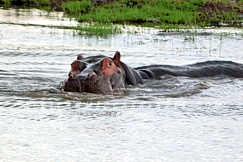
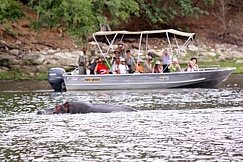
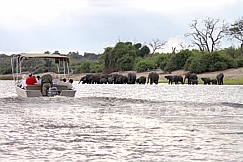
A boating safari on the Chobe riverfront provides another fantastic way to see wildlife up, close and personal either when bathing or drinking from the river or hanging around the river bank. Herds of trumpeting elephants can generally be seen while grunting hippo pods, water birds, and prehistoric crocodile can be best viewed in their natural wet habitat. The boating safari offers a perfect way to end your day watching the African sunset closing down on the Chobe River while sipping your cocktail.


Chobe Camp & Lodge Accommodations In Botswana
AFRICANMECCA REVIEWS
What are our Customers saying about our safari holidays?
On behalf of myself, my wife and my two adult daughters, I want to sincerely thank you and AfricanMecca Safaris for our fabulous recent safari. Everything you promised exceeded our expectations and was superb, which is saying a lot since this was our second trip, having had a wonderful Botswana Safari 10 years ago. Do not ever hesitate to use me as a reference.
Robert Schenkein - prVision Photography Studio - Colorado, United States
Chobe was delightful, less than half full. Sussi and Chuma, very nice, again only 13 people in all. All the game drives and river cruises were excellent. We had great weather. The ability to get really close is in inspiring. EVERYWHERE we went, the people were warm, helpful and charming. Thank you so much. We will be recommending your services to all.
Thomas Kelch - California, United States
Raza Visram at AfricanMecca planned the most amazing trip for my friend and I. I wanted to go to 4 countries in 15 days and he made it happen. It was an aggressive itinerary and Raza planned it so well, that the transitions were seamless. The last leg of the trip was Botswana for another Safari and we stayed at the most beautiful lodge. The excitement in seeing the animals so closely is indescribable.
Karin Alsdorf - New Jersey, United States
I had a wonderful trip to Africa and I would highly recommend your company.I have been to Africa many times and I have never had such wonderful service. The guide and safari vehicle were both great and all the lodges were outstanding. We will be going to Africa again the year after next and I assure you I will be contacting you. Thanks again for arranging such a great trip.
Ronald Price, President, Ron Price Motors Group - California, United States
Our Botswana safari was FANTASTIC! It truly was a luxury, but rustic enough, safari. We really loved our trip! We saw everything here. From lions to leopards to elephants to buffalos. Our guide, Rams was truly amazing. He really knew his stuff! While on the bush walks we encountered zebras, warthogs and much more. Thanks for your help! We will definitely do another trip within a year.
Duncan Rosen - Florida, United States
Thank you for everything; we had an amazing honeymoon. Words really can't describe our experience, all we can really say was that it was the most amazing experience of our lives and we would recommend AfricanMecca to anyone. We hope to visit Africa again sometime next year! Thank you & all of your staff for an amazing & perfect honeymoon.
Rick Sagoo - London, United Kingdom
CONTACT AND TALK TO OUR BOTSWANA TOUR EXPERTS TODAY TO START YOUR TRIP PLANNING PROCESS
Request Botswana Custom Or Tailor-Made Safari Vacation Pricing Based On Your Specific Travel Dates At Your Preferred Safari Tier Lodge Or Camp
CONTACT AN EXPERT ON BOTSWANA SAFARI PRICES & TOURS